Guide top › Knife types › Santoku — the 'three virtues' home knife
Santoku — the 'three virtues' home knife
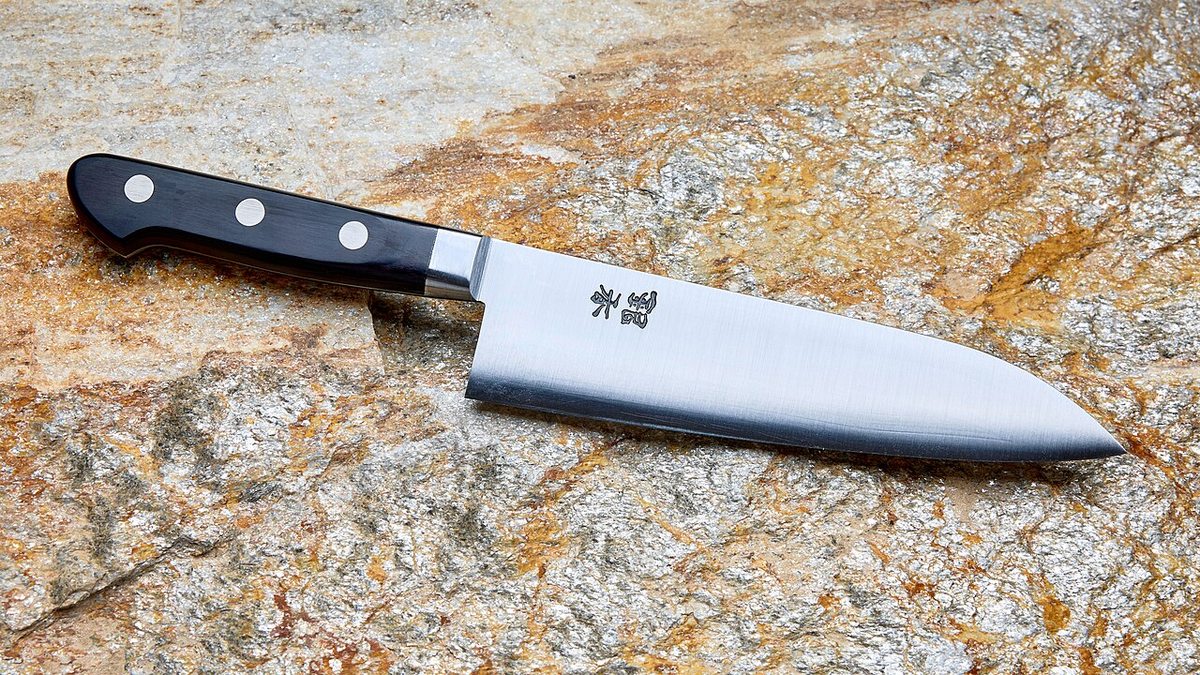
三徳包丁 (santoku-bōchō) — The santoku is Japan's home-kitchen all-rounder, typically 165–180 mm, with a wide blade and a sheep's-foot tip. Its name means 'three virtues' — slicing, dicing and mincing, or meat, fish and vegetables.
| Record type | Knife type |
|---|---|
| Origin | Japan |
| Japanese name | 三徳包丁 (santoku-bōchō) |
| Blade profile | Wide blade, flat edge profile, sheep's-foot tip |
| Edge | Double bevel |
| Typical length | 165–180 mm |
| Used for | Everyday slicing, dicing and mincing of meat, fish and vegetables |
Shorter and taller than a gyuto, the santoku keeps more of its edge flat against the board, which suits the up-and-down chopping motion common in home cooking. The blade tip curves down rather than rising to a point, making the santoku feel compact and safe in small kitchens. It is the most common knife in Japanese homes and the usual first recommendation for cooks who want one knife for daily meals.
The santoku traded the gyuto's long reach for control in a small space. For most home cooking, that trade is exactly right.
Why it suits home kitchens
At 165–180 mm the santoku is easy to handle over a home chopping board, and its tall blade keeps knuckles clear and works as a scoop for moving cut food. The flatter edge profile favours straight up-and-down cuts over rocking.
The 'three virtues' of the name are usually given as slicing, dicing and mincing — the three actions of everyday prep. In steel and price, santoku span the full range from stamped factory blades to hand-forged work from Sakai or Echizen.
Read alongside
Sources
- Santoku — Wikipedia (English) — Form, name and use of the santoku
- Japanese kitchen knife — Wikipedia (English) — Overview of Japanese kitchen knife types, bevels and steels
Record source: Wikipedia (English). Text is original to this guide, written from the cited sources. Wikipedia material is used under CC BY-SA. Official, association and maker pages were used for facts and figures only; no text or photographs were copied from them.