Guide top › Knife types › Nakiri — the rectangular vegetable knife
Nakiri — the rectangular vegetable knife
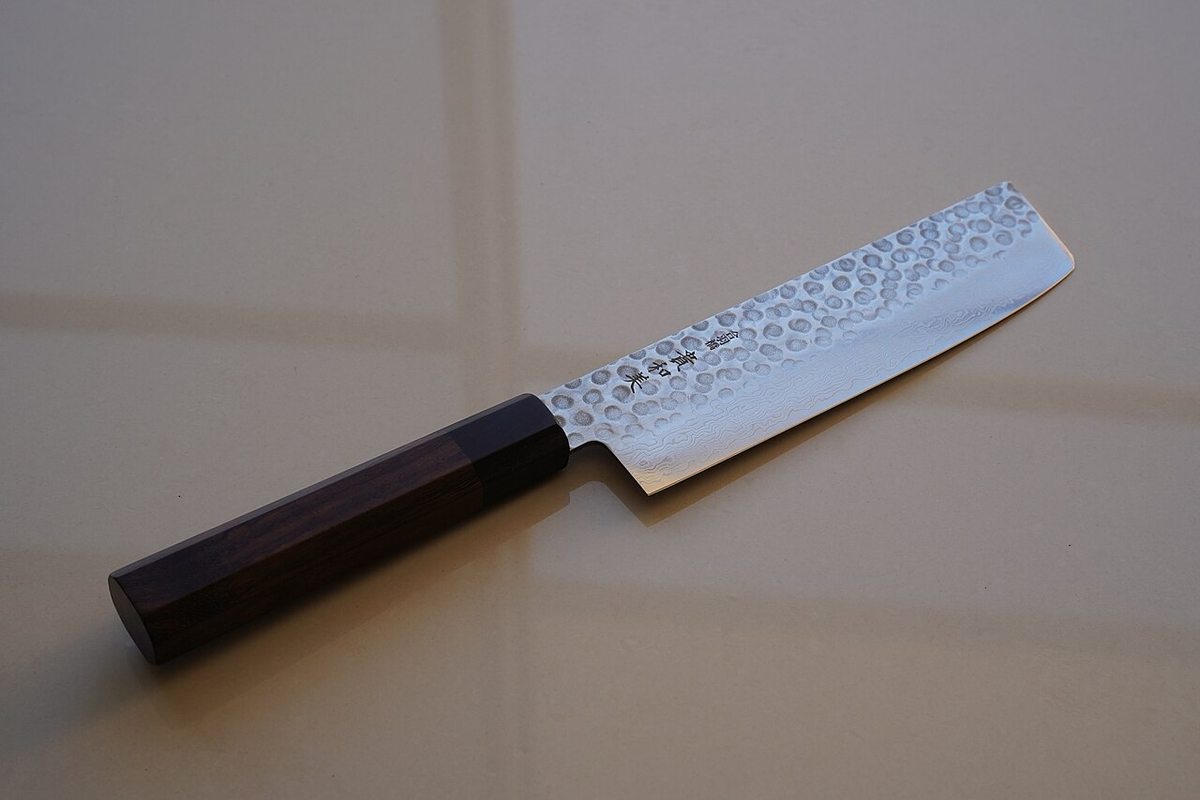
菜切包丁 (nakiri-bōchō) — The nakiri is a thin, rectangular double-bevel knife made for vegetables. Its straight edge meets the board along its whole length, so slices separate cleanly with a straight push cut.
| Record type | Knife type |
|---|---|
| Origin | Japan |
| Japanese name | 菜切包丁 (nakiri-bōchō) |
| Blade profile | Rectangular, tall and flat, thin behind the edge |
| Edge | Double bevel |
| Typical length | 150–180 mm |
| Used for | Vegetables — slicing, chopping and fine cuts |
With a blade 150–180 mm long and a flat profile, the nakiri looks like a small cleaver but is ground thin for produce, not bones. The tall blade guides straight cuts and scoops chopped vegetables easily. Regional forms exist — the square Kanto style and the rounded-tip Kansai kamagata style shared with usuba. A nakiri is the standard answer for cooks who prepare a lot of vegetables and want clean, even slices.
A nakiri makes vegetables feel easy: the whole edge arrives at the board at once, so nothing stays joined by a thread of skin.
A specialist that replaced guesswork
Because the edge is straight, a nakiri finishes each cut completely — no accordion slices. The thin blade passes through hard vegetables like squash and carrot with less splitting than a thick general-purpose knife.
The shape is often confused with a Chinese cleaver, but the nakiri is lighter and far thinner; it is a vegetable knife, not a bone chopper. Its single-purpose design is why it appears in so many Japanese home kitchens next to a santoku.
Read alongside
Sources
- Nakiri bocho — Wikipedia (English) — Form and vegetable use of the nakiri
- Japanese kitchen knife — Wikipedia (English) — Overview of Japanese kitchen knife types, bevels and steels
Record source: Wikipedia (English). Text is original to this guide, written from the cited sources. Wikipedia material is used under CC BY-SA. Official, association and maker pages were used for facts and figures only; no text or photographs were copied from them.