Guide top › Knife types › Usuba — the thin vegetable knife of the professionals
Usuba — the thin vegetable knife of the professionals
薄刃包丁 (usuba-bōchō) — The usuba ('thin blade') is a single-bevel vegetable knife for professional Japanese kitchens. It cuts sheets from daikon in katsuramuki rotary peeling and produces translucent vegetable slices.
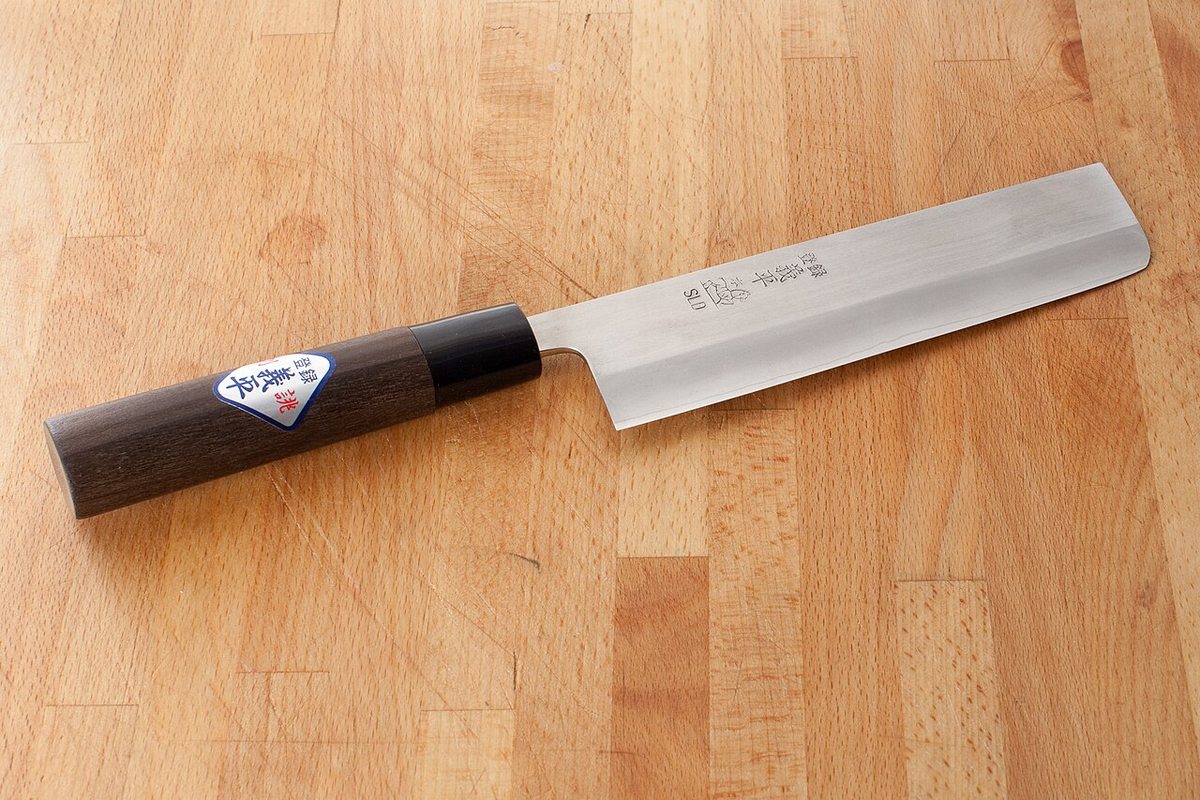
| Record type | Knife type |
|---|---|
| Origin | Japan |
| Japanese name | 薄刃包丁 (usuba-bōchō) |
| Blade profile | Rectangular and very thin; square (Kanto) or rounded (Kansai kamagata) tip |
| Edge | Single bevel |
| Typical length | 165–210 mm |
| Used for | Precision vegetable work: katsuramuki sheets, fine slices, decorative cuts |
Where the nakiri is the home vegetable knife, the usuba is its professional single-bevel counterpart: thinner, more delicate, and demanding better sharpening skill. The Kanto form has a square tip; the Kansai kamagata form has a rounded, half-moon tip. Lengths run 165–210 mm. The usuba's edge is fragile against hard rinds and boards struck carelessly, which is why it stays a specialist's tool.
The usuba rewards a skilled hand with cuts a nakiri cannot match — and punishes a careless one with a chipped edge. It is a professional's bargain.
Katsuramuki and precision work
In katsuramuki, the cook rotates a cylinder of daikon or cucumber against the blade and peels off a continuous translucent sheet, which is then cut into fine threads (ken). Only a very thin, very straight edge can do this evenly.
The usuba is also used for decorative cutting and for slicing vegetables so thin they transmit light. Home cooks are usually better served by the double-bevel nakiri; the usuba assumes whetstone skill.
Read alongside
Sources
- Usuba bocho — Wikipedia (English) — Form, regional tips and vegetable use of the usuba
- Japanese kitchen knife — Wikipedia (English) — Overview of Japanese kitchen knife types, bevels and steels
Record source: Wikipedia (English). Text is original to this guide, written from the cited sources. Wikipedia material is used under CC BY-SA. Official, association and maker pages were used for facts and figures only; no text or photographs were copied from them.