Guide top › Knife types › Gyuto — the Japanese chef's knife
Gyuto — the Japanese chef's knife
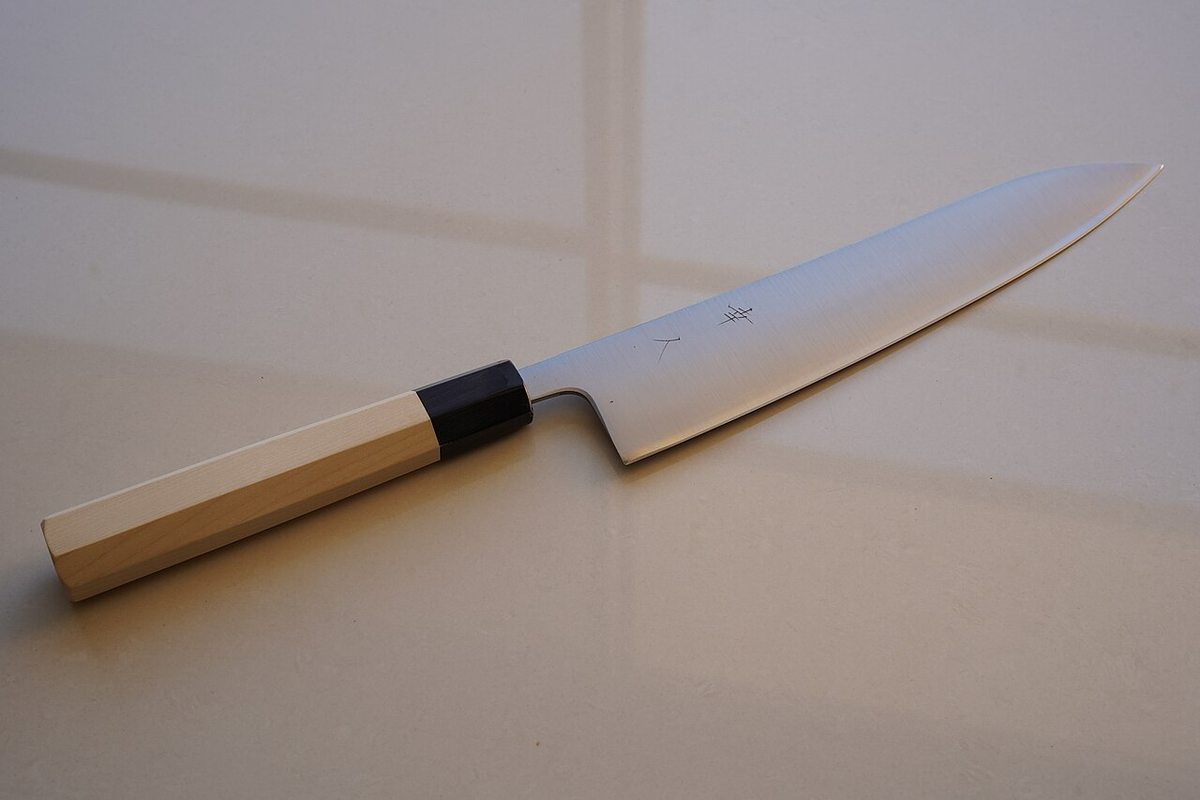
牛刀 (gyūtō) — The gyuto is Japan's version of the Western chef's knife: a double-bevel all-rounder for meat, fish and vegetables, most often 210 mm. Its name means 'beef knife', from the era when beef eating spread in Meiji Japan.
| Record type | Knife type |
|---|---|
| Origin | Japan (Western-influenced profile) |
| Japanese name | 牛刀 (gyūtō) |
| Blade profile | Gently curved belly rising to a pointed tip |
| Edge | Double bevel (usually 50/50 or asymmetric 70/30) |
| Typical length | 180–270 mm (210 mm most common) |
| Used for | Meat, fish and vegetables — the general-purpose kitchen knife |
The gyuto combines a Western-style profile with Japanese steel and thin grinding. The blade curves gently toward the tip so it can rock on the board, while the edge stays thin enough for clean push-cutting. Typical lengths run 180–270 mm, with 210 mm the common professional size. Gyuto are made in every blade region and in carbon, stainless and powder steels, which makes 'gyuto' a shape, not a quality claim.
If a cook owns one Japanese knife, it is usually this one. The gyuto does the work of a Western chef's knife with a thinner, harder blade.
Shape and use
The gyuto's edge curves along its length, deepest at the heel and rising to the tip. That curve supports both rocking cuts for herbs and long draw cuts for meat. Compared with a German chef's knife, a gyuto is typically thinner behind the edge and made of harder steel, so it cuts with less wedging but asks for more care on bones and frozen food.
Blade lengths run from 180 mm for small kitchens to 270 mm for professional work; 210 mm is the size most makers treat as standard.
Read alongside
Sources
- Gyuto — Wikipedia (English) — Profile, sizes and use of the gyuto
- Japanese kitchen knife — Wikipedia (English) — Overview of Japanese kitchen knife types, bevels and steels
Record source: Wikipedia (English). Text is original to this guide, written from the cited sources. Wikipedia material is used under CC BY-SA. Official, association and maker pages were used for facts and figures only; no text or photographs were copied from them.