Guide top › Knife types › Bunka — the santoku with a sword tip
Bunka — the santoku with a sword tip
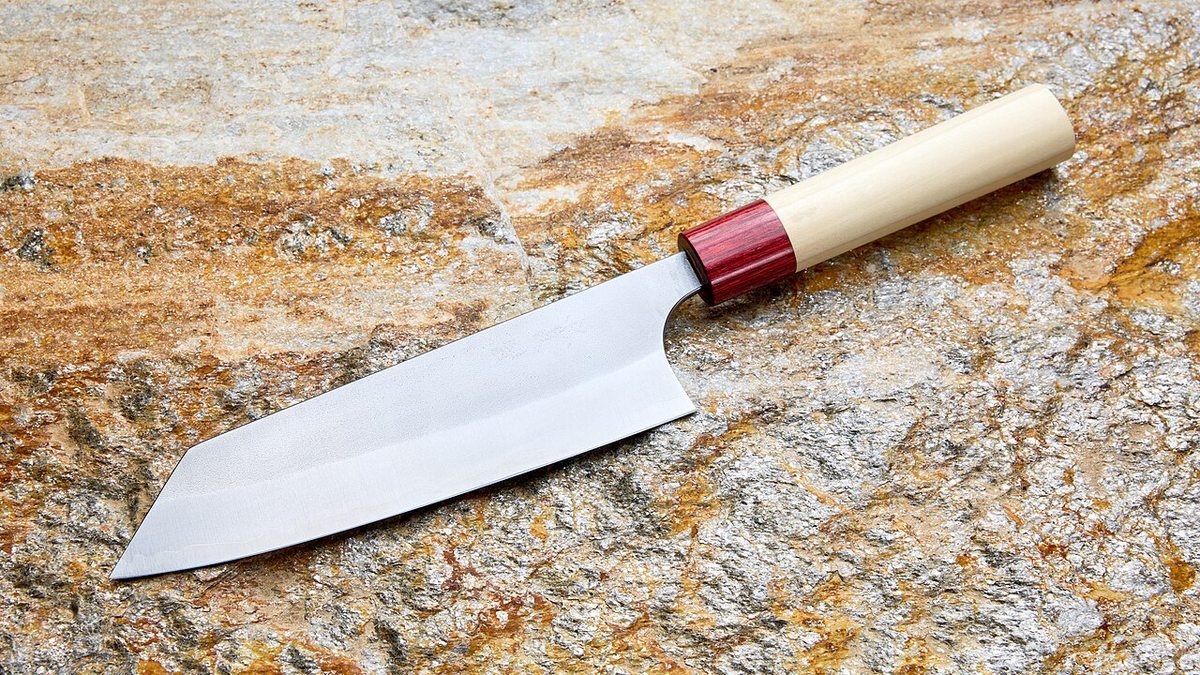
文化包丁 (bunka-bōchō) — The bunka is a double-bevel all-rounder like the santoku, but with a reverse-tanto tip that adds precision for detail cuts. Lengths are typically 165–180 mm.
| Record type | Knife type |
|---|---|
| Origin | Japan |
| Japanese name | 文化包丁 (bunka-bōchō) |
| Blade profile | Tall flat blade with a reverse-tanto (kiritsuke) tip |
| Edge | Double bevel |
| Typical length | 165–180 mm |
| Used for | Everyday meat, fish and vegetable prep, with a tip suited to detail work |
Bunka means 'culture' — the knife was a modern, cultured alternative to traditional forms when it appeared. It shares the santoku's tall blade and flat profile but ends in an angled kiritsuke-style tip, which is useful for scoring, garnish work and getting into corners of produce. Many Echizen makers feature the bunka prominently in their lines.
Same friendly size as a santoku, with a tip that can actually do fine work — the bunka is the all-rounder for cooks who found the santoku's tip limiting.
Santoku body, kiritsuke tip
The bunka keeps the santoku's flat edge and tall blade, so it chops and scoops the same way. The difference is the angled tip, which scores squid, trims fat and starts cuts in tight places where a sheep's-foot tip cannot reach.
Bunka are strongly associated with Echizen makers, several of whom offer the shape across carbon, stainless and powder steels.
Read alongside
Sources
- Bunka-bocho — Wikipedia (Japanese) — Form and naming of the bunka
- Japanese kitchen knife — Wikipedia (English) — Overview of Japanese kitchen knife types, bevels and steels
Record source: Wikipedia (Japanese). Text is original to this guide, written from the cited sources. Wikipedia material is used under CC BY-SA. Official, association and maker pages were used for facts and figures only; no text or photographs were copied from them.