Guide top › Knife types › Yanagiba — the sashimi knife
Yanagiba — the sashimi knife
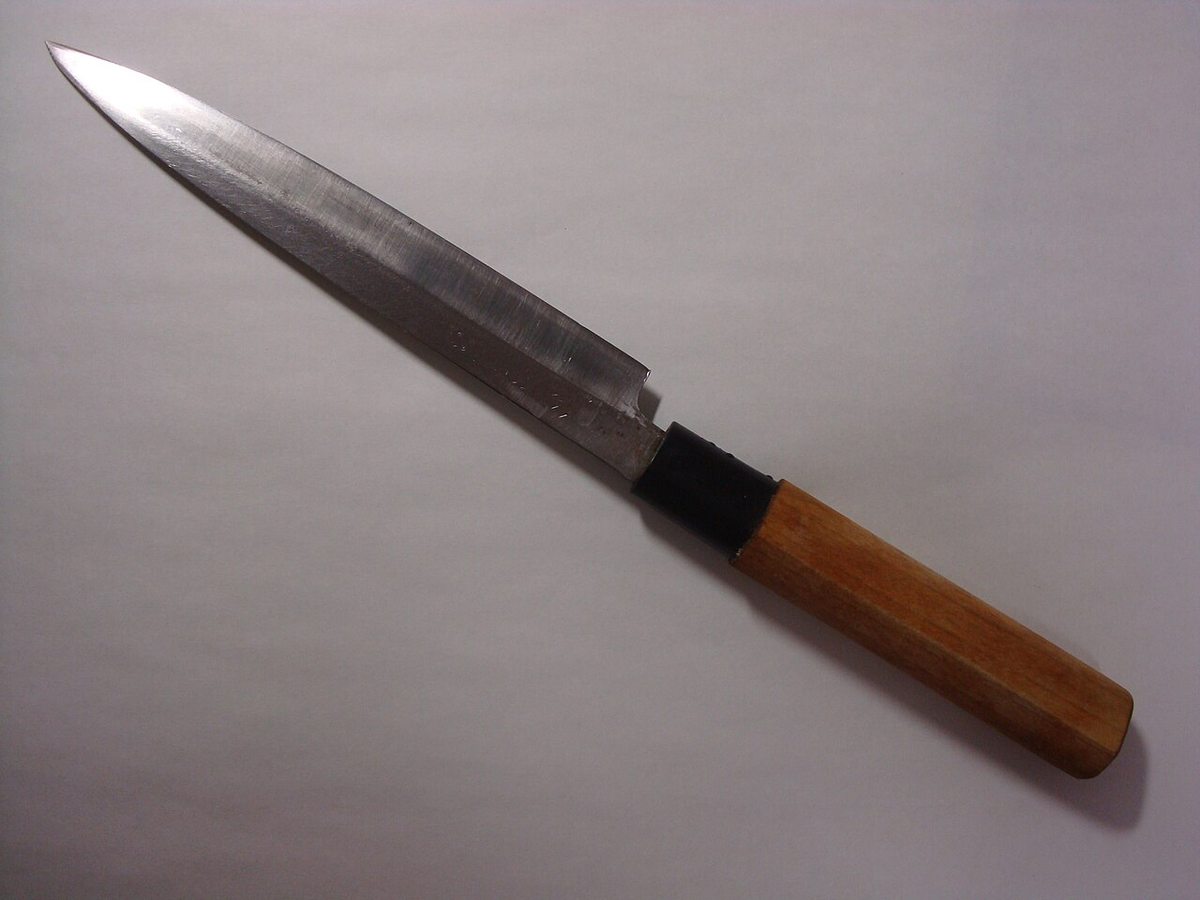
柳刃包丁 (yanagiba-bōchō) — The yanagiba is the long, single-bevel sashimi knife whose name means 'willow blade'. At 240–330 mm it slices raw fish in a single pull, leaving the cut surface glossy and undamaged.
| Record type | Knife type |
|---|---|
| Origin | Japan (Kansai form) |
| Japanese name | 柳刃包丁 (yanagiba-bōchō) |
| Blade profile | Long, narrow and thin with a pointed tip; hollow-ground back (urasuki) |
| Edge | Single bevel (right-handed standard; left-handed versions made) |
| Typical length | 210–330 mm (270–300 mm professional standard) |
| Used for | Sashimi and crudo — slicing raw fish in one pull |
A yanagiba is thin, narrow and pointed, ground on one side only, with a slightly hollow back (urasuki) that lets slices release cleanly. The length exists so a fillet can be cut in one drawing stroke — sawing would tear the flesh. Sizes from 210 mm (home) to 330 mm (professional) are made, with 270–300 mm standard in sushi kitchens. Forging and sharpening a yanagiba is considered a benchmark of a smith's and sharpener's skill, which is why Sakai's division of labour is built around knives like this.
Sashimi is cut, not sawn. The yanagiba's whole design — length, single bevel, hollow back — exists to make one pull produce a perfect slice.
One pull, one slice
The cook starts the cut at the heel and draws the full length of the blade through the fish in a single motion. A blade shorter than the cut forces a sawing motion that roughens the surface and dulls the shine that signals freshness.
The single bevel steers the knife in a shallow arc and presents a very acute edge; the hollow back reduces drag and lets the slice fall away from the blade instead of sticking.
A test of the maker
Long single-bevel blades show every forging and grinding fault, so yanagiba are a public test of both smith and sharpener. This is one reason Sakai, where forging and sharpening are separate trades, became the reference source for professional yanagiba.
Read alongside
Sources
- Yanagiba — Wikipedia (English) — Form and sashimi use of the yanagiba
- Japanese kitchen knife — Wikipedia (English) — Overview of Japanese kitchen knife types, bevels and steels
Record source: Wikipedia (English). Text is original to this guide, written from the cited sources. Wikipedia material is used under CC BY-SA. Official, association and maker pages were used for facts and figures only; no text or photographs were copied from them.