Guide top › Knife types › Soba-kiri — the noodle knife
Soba-kiri — the noodle knife
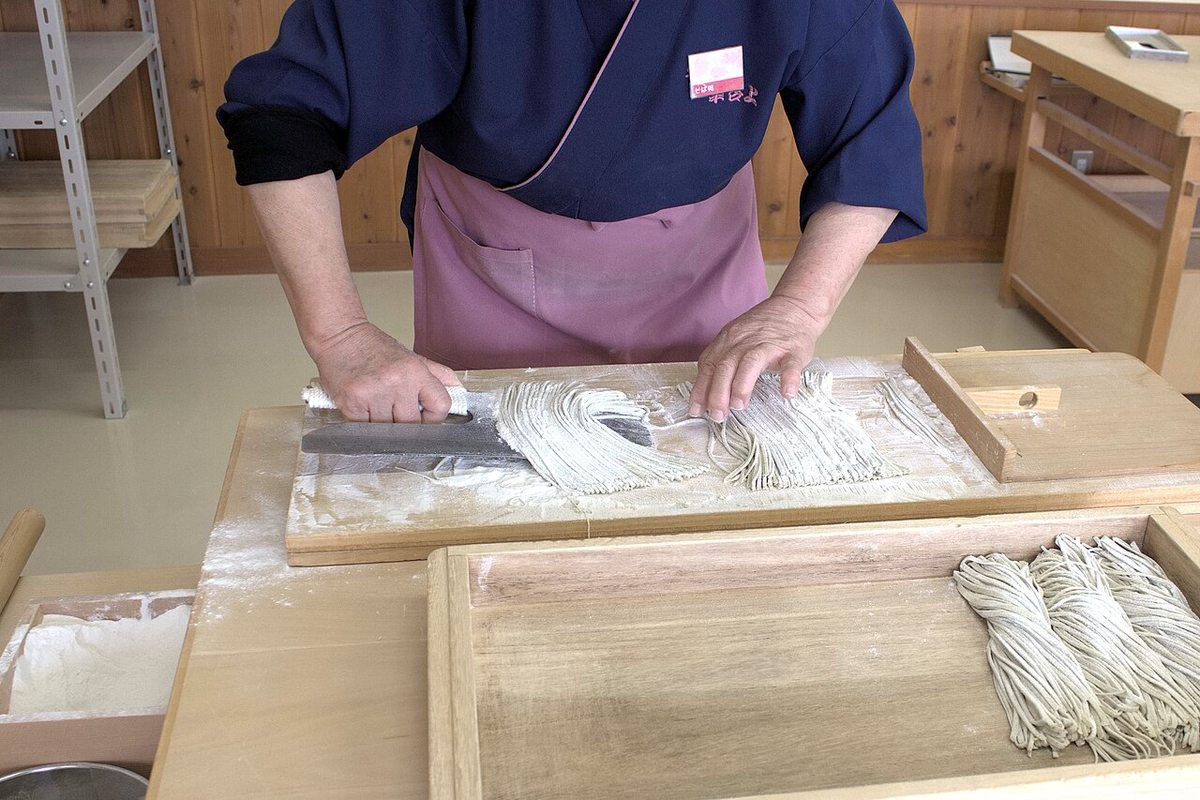
そば切包丁 (soba-kiri-bōchō) — The soba-kiri is a large specialised knife for cutting fresh soba noodles: a wide, straight blade used with a guide board (koma-ita) to slice a folded sheet of dough into even strands.
| Record type | Knife type |
|---|---|
| Origin | Japan (soba shops) |
| Japanese name | そば切包丁 (soba-kiri-bōchō) |
| Blade profile | Very wide straight blade; handle offset above the edge line |
| Edge | Single bevel (some double-bevel versions) |
| Typical length | 240–300 mm blade |
| Used for | Cutting fresh soba sheets into strands with a guide board |
Soba cutting is a rhythm task: the cook rocks the big blade forward against a wooden guide, feeding the dough sheet under it strand by strand. The soba-kiri's blade, usually 240–300 mm with an offset handle position, keeps knuckles above the board and the edge perfectly straight. Udon has its own related knife (menkiri). Outside noodle shops the type is rarely seen, which is what makes it a pure specialist.
No other knife in this guide has exactly one job. The soba-kiri cuts noodles — evenly, rhythmically, hundreds of strands at a time.
Cutting with a guide
The folded dough sheet rests on a board and a wooden guide (koma-ita) is pressed on top. The blade slides against the guide so each stroke advances by exactly one strand's width. Evenness of the strands is a visible measure of the shop's skill.
The offset handle keeps the cook's hand clear of the board through the long stroke, and the broad blade acts as its own straightedge.
Read alongside
Sources
- Soba kiri — Wikipedia (English) — The soba-cutting knife and technique
- Japanese kitchen knife — Wikipedia (English) — Overview of Japanese kitchen knife types, bevels and steels
Record source: Wikipedia (English). Text is original to this guide, written from the cited sources. Wikipedia material is used under CC BY-SA. Official, association and maker pages were used for facts and figures only; no text or photographs were copied from them.