Guide top › Knife types › Deba — the fish butchery knife
Deba — the fish butchery knife
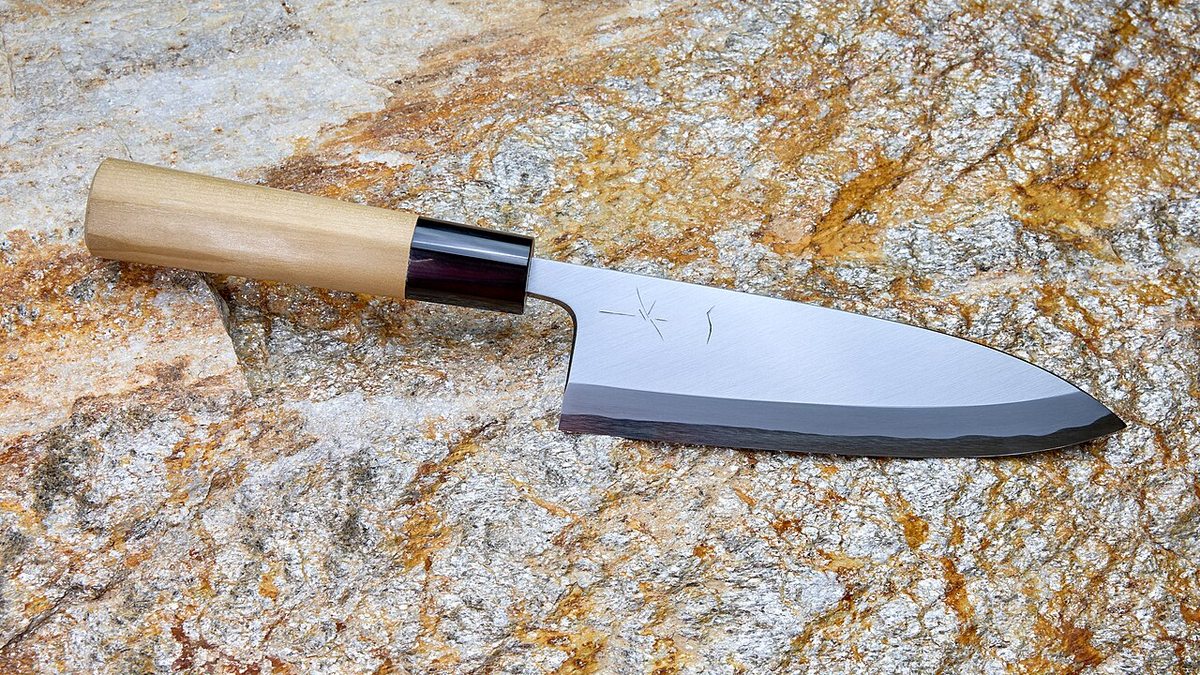
出刃包丁 (deba-bōchō) — The deba is a thick, heavy single-bevel knife for breaking down whole fish — removing heads, cutting through backbone and filleting. Its weight, not force, does the hard work.
| Record type | Knife type |
|---|---|
| Origin | Japan |
| Japanese name | 出刃包丁 (deba-bōchō) |
| Blade profile | Short, deep blade with a very thick spine tapering to a point |
| Edge | Single bevel |
| Typical length | 105–210 mm |
| Used for | Breaking down whole fish: heading, gutting, filleting |
A deba's spine can be several millimetres thick, giving it the mass to pass through fish bones and joints that would chip a thin slicing knife. The single-bevel edge fillets closely along the bone. Lengths run 105–210 mm, sized to the fish: small deba (ko-deba) for little fish, large deba for tuna-class work in markets. The deba is a butchery tool, not a general chopper — it is not made for frozen food or land-animal bones.
A deba looks overbuilt next to other Japanese knives, and that is the point: it is the one knife in the fish kit allowed to meet bone.
Weight as a tool
The thick spine puts mass behind the edge so the blade travels through a fish's head joint or backbone with a controlled push rather than a chop. The pointed tip works around bones when filleting, and the heel handles the heaviest cuts.
Deba are sharpened with a reinforced edge near the heel on some professional models. Even so, the knife is intended for fish bones and cartilage — not frozen blocks, and not as a cleaver substitute.
Read alongside
Sources
- Deba bocho — Wikipedia (English) — Form and fish-butchery use of the deba
- Japanese kitchen knife — Wikipedia (English) — Overview of Japanese kitchen knife types, bevels and steels
Record source: Wikipedia (English). Text is original to this guide, written from the cited sources. Wikipedia material is used under CC BY-SA. Official, association and maker pages were used for facts and figures only; no text or photographs were copied from them.